
What AI-Native Development Truly Means for Small Firms like KODA Kollectiv
The phrase "AI-native software development" is everywhere. But away from the enterprise marketing gloss, what does it actually mean for small-to-medium enterprises (SMEs) and boutique development shops?
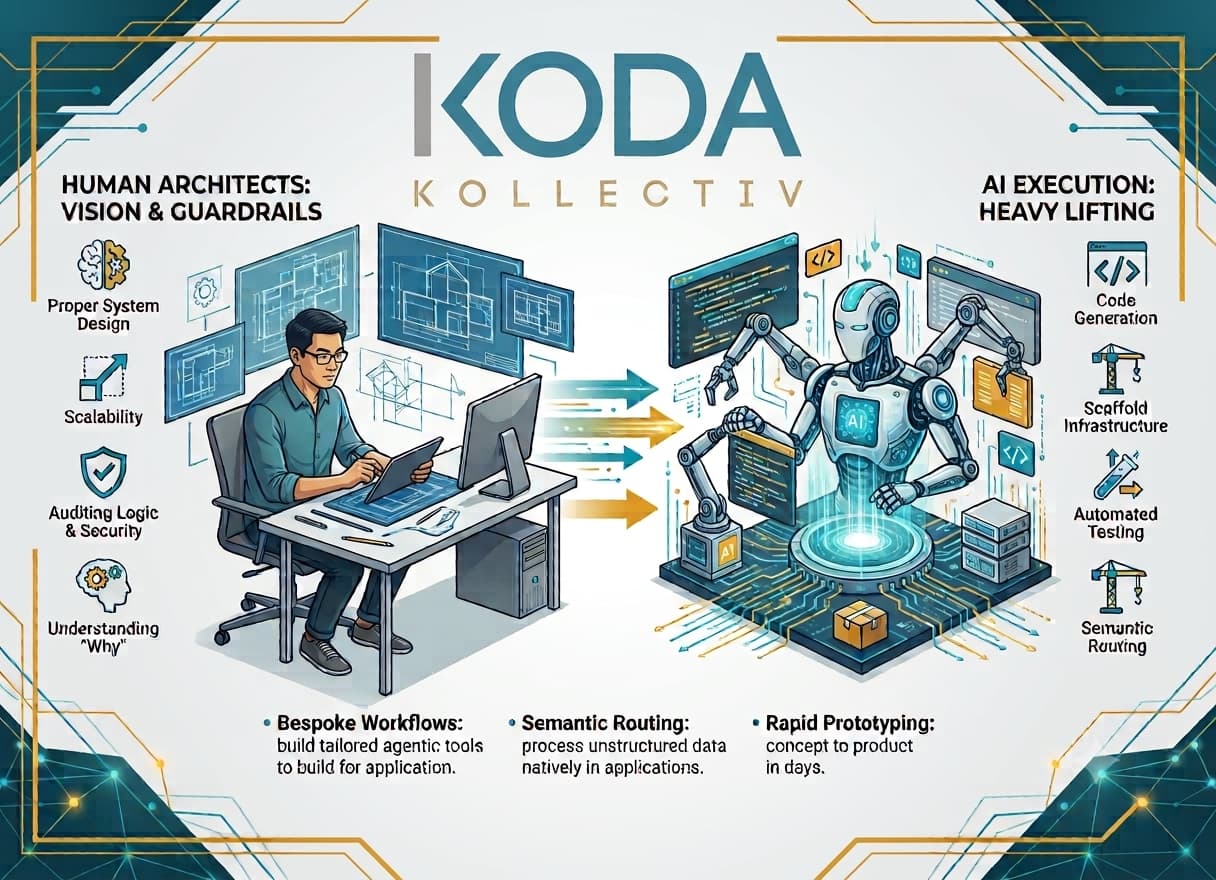
It does not mean a human developer sitting in front of a traditional screen while an autocomplete plugin guesses the next line of code. That was a few years ago. Today, AI-native means building software where artificial intelligence handles the heavy lifting of the implementation lifecycle, generating modules, scaffolding infrastructure, and running automated test suites based on human intent.
But can a small firm truly compete in this new landscape? Let's break down the reality of AI-native development for smaller teams.
The Reality Check: Scale vs. Agility
Let's be completely candid: a small dev shop or local agency is not going to ship a massive, multi-tenant global infrastructure project on par with a multi-national software conglomerate. Giant tech companies have access to vast pools of proprietary data, specialized multi-agent engineering squads, and massive budgets to sustain continuous model fine-tuning.
However, failing to match the sheer scale of a multi-national does not mean small firms are left behind.
In fact, the AI-native paradigm acts as an equalizer. Smaller firms can now deliver hyper-focused, small-scale AI-native projects with incredible speed. Where an SME used to spend months building a custom line-of-business application, they can now deploy intelligent, context-aware platforms in a fraction of the time.
Where SMEs Thrive in the AI-Native Era
Bespoke Workflows: Building highly tailored agentic tools that automate unique business operations.
Semantic Routing: Creating smart apps that process unstructured data natively without rigid, fragile database schemas.
Rapid Prototyping: Moving from a client's conceptual "intent" to a working, testable product in days instead of quarters.
The Catch: Why You Still Need an Expert Human Developer
With AI writing the lion's share of functional code blocks, it's easy to fall into the trap of thinking software development has become a "no-code" free-for-all. It hasn't. If anything, the shift to AI-native development has made expert human developers more critical than ever.
AI is exceptional at execution, but it lacks genuine foresight. Without an experienced developer steering the ship, an AI-native project can quickly devolve into a chaotic tangle of unmaintainable code.
The AI-Native Paradox: AI can generate a thousand lines of code in seconds, but it takes an expert human to ensure those thousand lines actually make logical sense together within a broader business architecture.
An expert human developer is indispensable for several reasons:
1. Proper Architecture and System Design
AI models operate probabilistically. They excel at modular tasks but struggle with high-level system boundaries, long-term maintainability, and data isolation. A human architect must design the blueprint to ensure the application scales safely without accumulating technical debt.
2. Guardrails and Logical Consistency
Left to its own devices, AI will occasionally hallucinate or take logic shortcuts that compromise security. A seasoned developer acts as the ultimate quality gate, auditing logic flows, ensuring strict security compliance, and verifying that the software behaves deterministically when it needs to.
3. Engineering the "Why," Not Just the "How"
AI is a machine of pure execution; it doesn't understand why a business operates the way it does. Human developers bridge the gap between abstract business strategy and technical reality, transforming vague user desires into precise programmatic intent.
Small Teams, Big Impact
AI-native development for small firms isn't about trying to out-build the tech giants. It's about leveraging AI as a powerful force multiplier.
By treating AI as an autonomous teammate rather than just a fancy search engine, small dev shops can slash time-to-market and provide boutique, high-value custom software to clients who previously couldn't afford it. But remember: the tool is only as good as the hand guiding it. To build digital products that last, the human engineer must remain the ultimate anchor of logic, security, and architectural integrity.
Embracing the Future: The KODA Kollectiv Approach
At KODA Kollectiv, we aren't just watching this shift happen from the sidelines, we are actively driving it. We have officially begun implementing AI-native development paradigms into our new projects, fundamentally changing how we architect and deliver software.
For our partners and clients, this shift translates directly into two massive advantages: unprecedented efficiency and significant cost-cutting. By offloading the tedious boilerplate code, routine refactoring, and initial scaffolding to advanced AI systems, our team can focus 100% of their energy on the high-level logic, bulletproof security, and robust system architecture that your business demands. You get the speed and budget advantages of cutting-edge AI, anchored securely by KODA's expert human developers.
The software landscape is changing fast, and you don't need a multi-national budget to leverage the absolute best of what technology has to offer today.
Are you ready to see what's possible when AI-native efficiency meets seasoned human engineering? Let's build the future together. Reach out to KODA Kollectiv today, and let's explore the endless possibilities of AI-native development for your next project.


CONTACT US
Contact us or give us a call to discover how we can help.
Email Address *
Full Name *
Location/Country *
Message *
Where Did You Hear About Us? *
OR EMAIL US DIRECTLY
Email: hello@kodakollectiv.com
OUR OFFICE
Address: 2nd Floor, Benedicto IT Center, AS Fortuna Street, Mandaue City, Cebu, Philippines 6014
Phone: +63 (961) 806-7601
(032) 384-1900